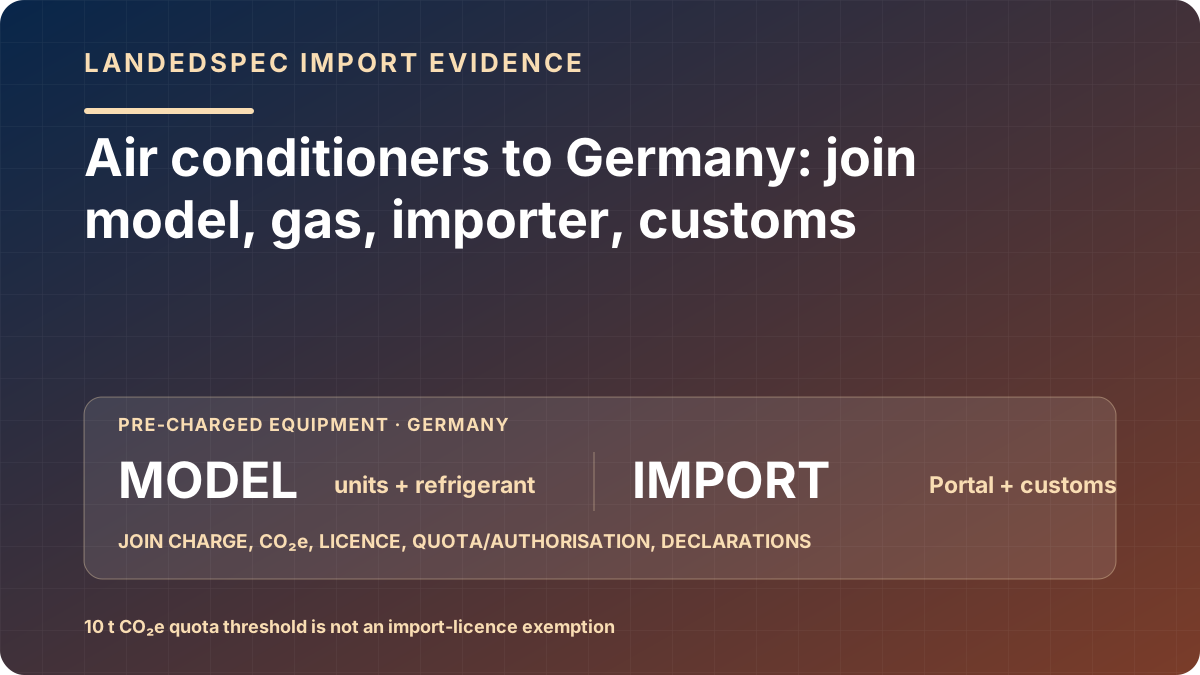
Short answer: how do you import air conditioners from China to Germany?
Before paying a deposit or booking freight, build one model-level import file that joins the exact indoor and outdoor units, refrigerant and charge, German importer and EORI, correct F-gas Portal registration and business specification, import licence, quota or authorisation where applicable, declaration and customs data, prohibition and label review, product and energy file, carrier acceptance, and final German delivery. A China invoice, CE mark, or DDP quote does not resolve these gates.
| Decision | Minimum buyer-controlled proof | Block the order when |
|---|---|---|
| Product and model | Exact category, indoor/outdoor combination, model list, units, intended use, and pre-charged status | A catalogue family or generic “air conditioner” line cannot be tied to the physical shipment. |
| Importer and Portal | German importer legal entity, EORI, active F-gas Portal registration, correct equipment-import business specification, and licence evidence | The Portal identity, business specification, licence, commercial file, and customs representative do not reconcile. |
| Gas and quota | Refrigerant, charge per unit, total mass and CO2e, applicable quota scope, and accepted authorisation or delegation | A quota threshold is being used as an import-licence exemption or the model totals do not reconcile. |
| Customs release | Procedure, commodity code, gas fields, declaration of conformity, supporting references, and broker check | The customs data conflicts with the model list, label, invoice, packing list, Portal, or authorisation evidence. |
| Product and energy file | Applicable declaration, technical documentation, label and product information, instructions, traceability, and German-market responsibilities | The exact model combination is outside the supplied file or a placing-on-market prohibition remains unresolved. |
| Freight and delivery | Carrier acceptance for the exact equipment and refrigerant, packages, weights, dimensions, Incoterm, German destination, and unloading plan | The freight quote relies on a generic cargo description or hides importer, customs, destination, or exception scope. |
Download the editable 42-field Germany air-conditioner F-gas and customs register
The starting file contains six unresolved example product families and one working row so a buyer can keep exact model combinations, gas and CO2e, importer and Portal identity, quota or authorisation, declaration, customs, product file, carrier, packing, delivery, owner, and next action on the same line. It is a decision worksheet, not an import licence, quota allocation, authorisation, classification, product approval, customs outcome, or substitute for responsible-party confirmation.
Identify the exact equipment configuration
Separate portable units, single-split systems, multi-split combinations, heat pumps, larger commercial equipment, uncharged components, and spare parts. Record indoor and outdoor model combinations, rated cooling/heating capacity, voltage/frequency, refrigerant type and charge, package count, dimensions, weights, accessories, and intended German sales channel.
Different configurations can change the applicable product requirements, F-gas workflow, energy information, dangerous-goods review, freight allocation, and installation responsibility. A generic “air conditioner” description is not enough for the purchase order or customs file.
Resolve the F-gas decision before the order
The European Commission states that importers of relevant pre-charged refrigeration, air-conditioning, and heat-pump equipment need the appropriate F-gas Portal registration/import licence before import, and that HFC-containing equipment within the quota framework needs sufficient authorisations before release for free circulation. Required customs-declaration information, labelling, prohibitions, and reporting questions depend on the refrigerant and equipment.
Use the Commission source below and obtain product-specific professional confirmation. Do not treat a supplier statement, a refrigerant label, or a freight booking as proof that the importer, authorisation, quota, and customs requirements are resolved.
Why the German importer file must be executable
In April 2024, Hamburg customs reported stopping 170 heat pumps from China after deficient markings created product-conformity concerns. The responsible market-surveillance authority confirmed the concerns, so the importer had to remedy the equipment or could not place it on the German market.
That heat-pump event does not prove that every air-conditioner shipment will be stopped, and it is not evidence about a particular supplier. It does show why a freight booking and supplier assurance are not release gates: the exact product, marking, importer, and supporting file must survive customs and market-surveillance review.
Separate licence, quota, declaration, and customs gates
A valid registration/import licence is not the same gate as HFC quota coverage. Germany's Umweltbundesamt says F-gas Portal registration and the resulting import licence are required for imports of F-gases listed in Annexes I, II, and III regardless of their global-warming potential or amount. The European Commission separately states that the minimum HFC quantity in imported products or equipment that must be covered under the quota system is 10 t CO2e. Do not use that quota threshold as an import-licence exemption.
| Gate | Buyer-controlled evidence | Do not proceed when |
|---|---|---|
| Importer and licence | Importer legal entity, F-gas Portal registration ID, EORI, customs procedure, and broker reconciliation | The entity in the Portal, authorisation, commercial file, or customs declaration does not reconcile. |
| Model and gas list | Exact model combination, units per model, HFC type, charge per unit, total kilograms, and total CO2e | A catalogue family or supplier total cannot be reconciled to the physical units and customs lines. |
| Quota and declaration | Applicable authorisation or delegated-authorisation reference, accepted quantity, and signed declaration of conformity | The authorisation route, quantity, acceptance, or declaration remains unresolved for the shipment. |
| Customs and market placement | Commodity code, gas mass, CO2e, licence, labels, prohibition screen, and supporting product documents | Required declaration data conflicts with the model list, invoice, packing list, label, or product file. |
| Reporting and verification | Importer-level annual activity total, reporting threshold assessment, verification threshold assessment, responsible owner, and due date | A shipment-level worksheet is being mistaken for the importer’s annual reporting or auditor determination. |
Commission Implementing Regulation (EU) 2025/2155 makes the model list operational: for imported pre-charged equipment it specifies model information, units per model, HFC type, charge per unit rounded to the nearest gram, and totals in kilograms and tonnes of CO2 equivalent. These are evidence fields, not permission for LandedSpec to select a gas value, scope outcome, authorisation, or customs treatment.
Energy and product-information file
For air conditioners within the relevant scope, EU ecodesign and energy-labelling requirements cover minimum energy performance, sound and product information. Build a model-level file covering the applicable declaration and technical documentation, model combination, energy label and product information, instructions, German-language requirements, markings, traceability, and EPREL responsibilities where applicable.
China-to-Germany logistics and cost stack
| Cost or route field | Buyer question |
|---|---|
| Equipment and packing | How many indoor/outdoor units, pallets or cartons; what are the gross weights, dimensions, stacking limits, and moisture/impact controls? |
| Refrigerant and freight | Does the exact refrigerant/charge affect carrier acceptance, documentation, handling, or mode selection? |
| Customs and compliance | What are the line-level classification, valuation, origin, F-gas, energy/product, and importer assumptions? |
| Destination execution | Who handles terminal charges, broker, inspection, inland delivery, appointment, unloading, storage, and exceptions in Germany? |
| Unit economics | How are freight and shared charges allocated across indoor units, outdoor units, accessories, and spares? |
Model the cash requirement and economic cost separately in the landed-cost calculator. Import VAT may be recoverable while remaining a working-capital requirement.
Pre-booking evidence checklist
- Line-level model and configuration dictionary
- Refrigerant type, charge, labels, and F-gas workflow confirmation
- Importer registration/licence and authorisation questions resolved where applicable
- Applicable declarations, technical documentation, energy label/information, instructions, and traceability
- Final commercial invoice and packing-list drafts aligned
- Carrier/forwarder acceptance of the exact equipment and refrigerant profile
- German broker and destination-delivery instructions
Build the customs-ready F-gas model list
Download the Germany air-conditioner F-gas and customs register. It keeps the importer, Portal, EORI, procedure, model, unit count, refrigerant, per-unit charge, total kilograms, CO2e, quota/authorisation, declaration, commodity-code, label, prohibition, reporting, verification, energy-file, carrier, packing, and German-delivery fields in one reviewable row.
The six example product families deliberately leave gas quantities, GWP values, CO2e, scope, authorisations, and customs outcomes unresolved. Replace them with transaction evidence and responsible-party confirmation. Use the separate mixed-HVAC line-item register for accessories, uncharged components, freight drivers, and shared-cost allocation. Keep pre-charged equipment on distinct rows from uncharged parts and spares.
Decision gate
Do not release the deposit or freight booking until the importer role, exact refrigerant/charge, F-gas route, model-level product file, packing profile, and German destination plan are explicit.
Dataset reuse: license, attribution, and source terms.
Primary sources
Official sources used to frame the guidance. Check the current product and transaction before acting.
- European Commission: Importing into the EU
- European Commission: EU Customs Tariff (TARIC)
- European Commission: EORI number
- European Commission: Importers and distributors
- European Commission: F-gases in equipment and products
- European Commission: F-gas Portal registration guide for undertakings
- EUR-Lex: Regulation (EU) 2024/573 on fluorinated greenhouse gases
- EUR-Lex: Implementing Regulation (EU) 2025/2155 declaration and model-list requirements
- German Environment Agency: F-gas imports and exports FAQ
- German Customs: Hamburg heat-pump import stopped over product-conformity concerns
- European Commission: Air conditioners and comfort fans
Are your supplier quotes ready to compare?
Answer eleven structured questions and get a private HOLD, VERIFY, or READY TO COMPARE result without entering your identity.