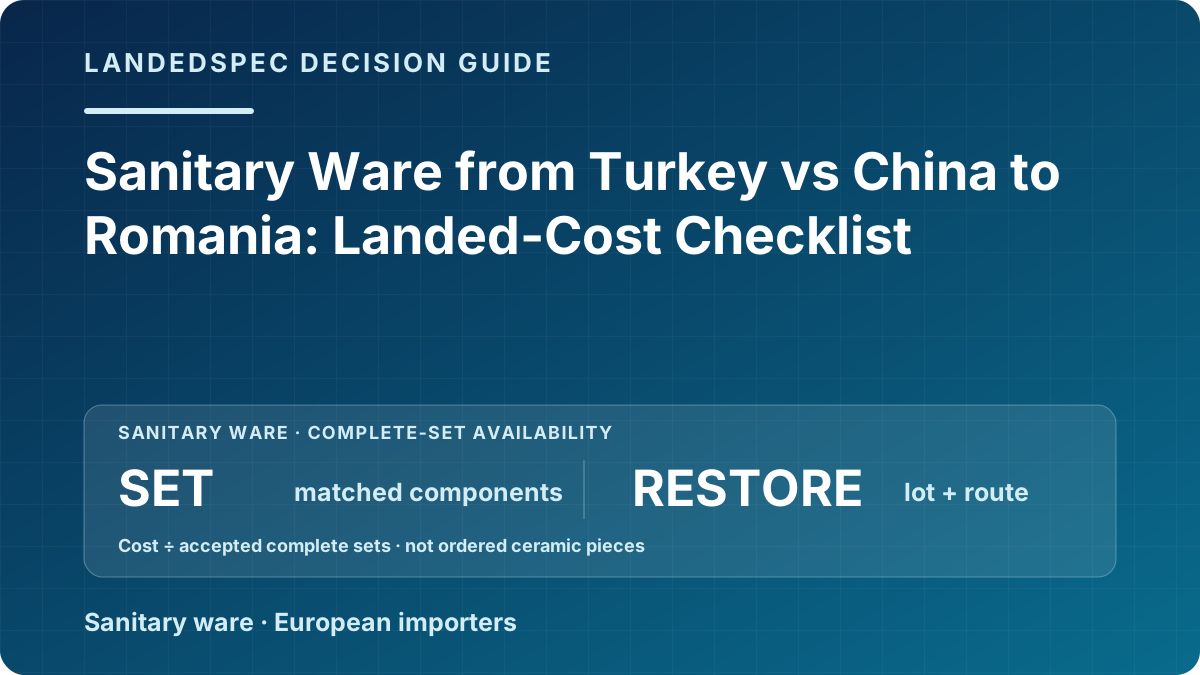
A Romania importer comparing ceramic sanitary ware from Turkey and China should not choose from factory price alone. Toilets, cisterns, wash basins, pedestals, bidets, and urinals combine fragile-unit risk with product-specific evidence, high packaging volume, mixed-model orders, and costly replacement gaps.
The useful decision is not "which country is cheaper?" It is "which supplier can deliver the required saleable mix to the Romanian receiving point, with usable product evidence and a replenishment plan, at the lower cost per saleable unit?"
This page keeps that decision inside LandedSpec's current concept: one product family, two origins, one destination, and a transparent evidence-and-cost model before the purchase order.
Short answer: Turkey or China for sanitary ware to Romania?
Neither origin wins automatically. Compare the actual Turkish and Chinese suppliers on the same model and accessory list, required product evidence, carton and pallet design, breakage and complete-saleable-set assumptions, Incoterm and named place, customs and origin evidence, route, replacement lot, replenishment time, and delivered cost per accepted set in Romania. A lower factory price loses when missing components, fragile packing, poor mixed-model availability, or slow replacements reduce saleable output.
Delivered cost per accepted complete set = delivered operational cost ÷ accepted complete saleable sets. Run that formula for the Turkish and Chinese offers with the same Romanian delivery point, component map, acceptance rule, and evidence-dated scenario. Do not divide by ordered ceramic pieces: intact but unmatched pans, cisterns, seats, mechanisms, or accessories cannot be counted as a saleable set.
| Ordered physical units | Intact units after transit | Accepted units after receiving | Matched complete sets |
|---|---|---|---|
| Count every required component by model and colour | Apply only a stated, evidence-labelled transit scenario | Apply the receiving inspection and reject rule | Use the lowest matched quantity across every required component |
| Delivered operational cost | VAT cash | Delivered cost per accepted complete set | Availability-restoration cost |
|---|---|---|---|
| Landed economic cost plus expected inspection, repacking, disposal, claim, and executable restoration allowances | Show recoverable import VAT separately from economic cost | Divide delivered operational cost by accepted complete saleable sets | Price the minimum executable replacement lot, route, customs, receiving, and delay exposure |
Romania's recorded HS 6910 imports: Turkey versus China
Eurostat Comext reports that Romania imported 19.65 million kilograms of HS 6910 ceramic sanitary fixtures from outside the EU in 2025, with a reported trade value of EUR 25.16 million. China supplied 11.44 million kilograms, or 58.21% of recorded extra-EU quantity, and EUR 15.61 million, or 62.05% of recorded value. Turkey supplied 1.66 million kilograms, or 8.44% of quantity, and EUR 3.19 million, or 12.68% of value.
| 2025 Romania extra-EU imports, HS 6910 | Turkey | China |
|---|---|---|
| Reported quantity | 1.66 million kg | 11.44 million kg |
| Share of extra-EU quantity | 8.44% | 58.21% |
| Reported trade value | EUR 3.19 million | EUR 15.61 million |
| Share of extra-EU value | 12.68% | 62.05% |
| Change in quantity from 2024 | -11.4% | +22.7% |
Source: Eurostat Comext dataset DS-045409, EU trade since 1988 by HS2-4-6 and CN8. The extraction uses annual frequency, reporter Romania, import flow, product 6910, partners Turkey, China and Extra-EU27, and reported quantity and value indicators. Data was extracted 11 July 2026; the API reported a last update of 15 June 2026. Shares, changes and implied values are LandedSpec calculations.
Download the source-labelled 2024–2025 Romania HS 6910 CSV to reuse the reported values, calculations and evidence boundary.
This is an origin-screening signal, not a supplier ranking or a price benchmark. HS 6910 groups multiple ceramic sanitary-fixture types and does not prove that the reported Turkish and Chinese goods share the same material, model, quality, packing, Incoterm or commercial terms. It also does not classify seats, frames, taps, furniture, mechanisms or mixed bathroom kits. Use the data to understand recorded sourcing scale; use line-level product evidence and live quotations to decide the purchase.
Define the commercial and physical lines first
Do not accept one quotation line called "bathroom sanitary ware." Separate every commercial and physical product that customs, freight, receiving, installation, or replacement teams may need to identify independently.
At minimum, record:
- WC pan or complete WC set;
- exposed or concealed cistern;
- wash basin and pedestal;
- bidet or urinal;
- toilet seat and cover;
- flushing mechanism, valves, fixings, connectors, and other accessories;
- furniture, mirror, tap, frame, or electronic component sold with the ceramic item;
- model, colour, dimensions, outlet and inlet configuration, mounting type, and drawing revision;
- pieces per sales pack, export carton, crate, and pallet.
The European Commission's customs nomenclature describes heading 6910 as ceramic sinks, wash basins, wash-basin pedestals, baths, bidets, water-closet pans, flushing cisterns, urinals, and similar sanitary fixtures. That is a useful screening boundary, not permission to place every bathroom component under one code. Seats, mechanisms, frames, taps, furniture, electronics, and mixed kits still need line-level review.
Use the construction-material RFQ template to give both suppliers the same model list, required evidence, packing response, Incoterm, named place, and acceptance criteria.
Compare Turkey and China on one Romania decision table
Do not award either origin a generic advantage. Make each supplier prove the route, lot size, packing, evidence, and replacement model behind the offer.
| Decision field | Turkey offer | China offer | Buyer-controlled comparison |
|---|---|---|---|
| Product match | Model, dimensions, water and outlet configuration, finish, accessories | Same fields | Reject substitutions hidden behind a family description |
| Order structure | MOQ by model and colour; mixed-load rules | MOQ by model and colour; mixed-container rules | Compare the saleable assortment, not only total pieces |
| Route | Named road, short-sea, or multimodal plan and handoffs | Named ocean, rail, or multimodal plan and handoffs | Price both to the same Romanian delivery address |
| Packaging | Carton or crate drawing, pallet plan, gross weight, stackability | Same evidence | Compare pieces and expected saleable pieces per loading unit |
| Product evidence | Model-level declaration, test, marking, and installation documents | Same evidence | Record applicable document rather than accepting "CE available" |
| Customs evidence | A.TR status path where applicable, invoice, packing list, classification inputs | Origin and classification inputs, invoice, packing list | Keep customs status, origin, and product evidence as separate fields |
| Replenishment | Replacement MOQ, dispatch basis, route, and document path | Same evidence | Model time and cost to restore one missing bathroom set |
The comparison should expose a conditional result. A closer-origin offer can still lose if packaging, model control, or claim handling is weak. A lower factory-price offer can still lose if it requires more stock, produces incomplete sets, or makes single-model replenishment uneconomic.
Treat A.TR as customs-status evidence, not origin evidence
For industrial goods within the EU-Türkiye Customs Union, the European Commission explains that an A.TR movement certificate establishes the customs status of goods in free circulation. It does not, by itself, certify that a sanitary product is of Turkish origin.
Keep three separate questions in the buyer file:
- Is the product within the relevant customs-union scope?
- Can the shipment provide valid A.TR evidence for the goods in free circulation where applicable?
- What non-preferential origin will be declared, and which manufacturing evidence supports it?
This distinction matters when a Turkish seller distributes goods manufactured elsewhere. Do not turn "shipped from Turkey" or "A.TR available" into an unsupported Turkish-origin statement. Confirm the transaction-specific customs treatment and documents with the responsible broker before dispatch.
Build a model-level performance and document gate
Sanitary appliances can sit within the EU construction-products framework. The European Commission describes harmonised standards as the technical basis manufacturers use to assess construction-product performance, draw up a Declaration of Performance, and affix CE marking where the product is covered.
Official Journal references include EN 997 for WC pans and WC suites with integral trap and EN 14688 for wash basins. Other sanitary product families can have different specifications. Therefore, do not request one generic "CE certificate" for the whole container.
For each model, record:
- intended use and exact product family;
- applicable harmonised technical specification, if any, checked against the current official reference;
- Declaration of Performance reference and declared characteristics where required;
- CE marking and accompanying information where required;
- test report or other evidence supporting the declared model and variant;
- manufacturer identity and traceability reference;
- installation, maintenance, cleaning, and safety information required for the buyer's market and use;
- language and label actions before the product reaches the Romanian customer or site.
A test report for one basin shape does not automatically cover another model, size, mounting method, or factory. Make the supplier show the coverage relationship instead of assuming it.
Use the supplier-document evidence register to connect the purchase-order line, model evidence, shipment document, status, owner, and next action.
Do not mix the two CPR transition paths
Regulation (EU) 2024/3110 applies from 8 January 2026, but that date does not move every sanitary product onto one new document route. Article 95 says harmonised standards that were cited and in force on that date remain valid under Regulation (EU) No 305/2011 until they are withdrawn or otherwise repealed by the Commission. The retained provisions of Regulation (EU) No 305/2011 continue to apply to products covered by those transition standards.
For each quoted model, record the applicable harmonised standard, its current Official Journal status, the legal route used for placing the product on the market, the required declaration format, the manufacturer and importer checks, and the date and source of that conclusion. Do not select the route from shipment date, a generic “new CPR” statement, or the presence of a CE mark alone.
The buyer file should show whether the supplied declaration, marking, technical evidence and Romanian-language information match the exact product type and the applicable transition path. If the Commission withdraws or replaces the cited standard, reopen the evidence decision before the next order instead of carrying the prior approval forward.
Price packaging as part of the product
For fragile sanitary ware, the export pack controls both freight utilization and saleable yield. Ask for evidence before accepting a loading quantity:
- item protection method and contact points;
- carton or crate external dimensions and gross weight;
- pieces per carton, pallet, and loading unit;
- pallet dimensions, total height, and stackability limit;
- mixed-model pallet plan and label format;
- internal supports and separation between ceramic and metal parts;
- loading diagram and photos from a comparable shipment;
- handling symbols, fork-entry points, and receiving instructions;
- supplier packing specification and change-control reference.
The lowest cubic metres per piece is not automatically the best result. Excessive nesting, contact, weight, or mixed-model complexity may move cost from origin packing into breakage, counting, repacking, claims, and incomplete sets in Romania.
The supporting guide on questions before booking construction-material freight explains why packaging evidence belongs before the route commitment.
Calculate cost per saleable set, not ordered piece
Sanitary-ware orders often contain linked components. A usable WC set may require the pan, cistern or frame interface, seat, mechanism, fixings, and model-specific accessories. One damaged or missing component can make the rest of the set temporarily unsaleable.
Build these outputs for each supplier:
- Ordered units by physical line.
- Expected intact units after the stated transit-breakage scenario.
- Expected accepted units after the receiving inspection and reject rule.
- Accepted complete saleable sets after matching required components by model and colour.
- Incomplete or unmatched accepted components kept visible as an availability gap.
- Landed economic cost before recoverable import VAT.
- Delivered operational cost including expected local inspection, repacking, disposal, claim, and executable restoration allowances.
- Delivered cost per accepted complete saleable set.
- Import VAT cash requirement shown separately from economic cost.
Run at least three clearly labelled planning scenarios rather than publishing an invented universal breakage rate:
- supplier-supported case using evidenced packaging and claim assumptions;
- buyer base case using the current internal receiving history;
- stress case covering a plausible pallet, model, or accessory failure.
Do not reduce the stress case to a percentage only. Ask which model becomes unavailable, how many complete sets remain, and what the restoration route costs.
Enter the normalized economic and cash values in the construction-material landed-cost calculator.
Make replenishment a purchase-order decision
The first shipment is not the whole sourcing decision. A Romania distributor, retailer, hotel contractor, or residential-project buyer may need replacements for transit damage, site damage, warranty claims, or a single missing component.
Before approval, obtain:
- replacement MOQ by model and component;
- whether the supplier can ship one component without a complete set;
- production and dispatch basis for replacement stock;
- packing method for small replacement lots;
- route and customs-document path for replenishment;
- colour, glaze, mould, and revision controls across production batches;
- claim evidence deadline and credit or replacement mechanism;
- discontinuation notice and spare-component availability policy.
Compare the landed cost of restoring availability, not only the promised factory replacement. A "free" replacement item can still create freight, brokerage, customs, receiving, and delay costs.
Download the sanitary-ware comparison register
Download the Turkey-versus-China sanitary-ware comparison register. It keeps buyer requirements, both supplier responses, evidence references, status, owner, and next action on one sheet.
The register contains product, customs, performance, packing, route, breakage, complete-set, replenishment, and cost-output rows. It contains no supplier price, duty, VAT, freight, lead-time, or breakage claims. Add current transaction values and preserve source dates.
Approval gate for the Romania buyer
Do not issue the purchase order until the file shows:
- the same controlled model and component structure for both suppliers;
- a model-level evidence decision rather than a generic certificate promise;
- a line-level classification list and confirmed customs treatment;
- separate A.TR, free-circulation, and origin fields for the Turkey offer;
- carton, pallet, loading, weight, and stackability evidence;
- expected complete saleable sets under base and stress scenarios;
- one normalized Romanian delivery point and Incoterm basis;
- replacement MOQ, component availability, document path, and restoration cost;
- separate landed economic cost and import VAT cash requirement;
- an owner and next action for every unresolved item.
For adjacent Romania decisions, compare aluminium profiles from China and Turkey and the steel-fastener classification and landed-cost workflow. For another fragile ceramic category, see the porcelain-slab landed-cost guide.
Primary references
- European Commission: Section XIII customs nomenclature, including heading 6910
- European Commission: Türkiye customs union and A.TR movement certificates
- European Commission: tariff classification of goods
- European Commission: calculation of customs duties and customs valuation
- European Commission: Construction Products Regulation
- EUR-Lex: Regulation (EU) 2024/3110, including Article 95 transition provisions
- EUR-Lex: consolidated Regulation (EU) No 305/2011
- European Commission: harmonised standards for construction products
- EUR-Lex: Official Journal references including EN 997 and EN 14688
- European Commission: import VAT taxable amount
This guide is for procurement planning. Final classification, customs treatment, origin, product obligations, tax handling, and shipment execution should be confirmed with the responsible customs, product-compliance, logistics, and tax professionals for the specific transaction.
Dataset reuse: license, attribution, and source terms.