Paying a deposit too early can lock a buyer into the wrong supplier, the wrong product assumption, or the wrong shipping plan. For construction materials, document gaps often show up before the cargo moves. That makes the pre-deposit stage one of the best moments to reduce risk.
This review does not need to become a legal exercise. The useful question is simpler: do the supplier documents prove that the supplier understands the order, can describe the product clearly, and is preparing the shipment in a way your team can actually execute?
Use the primary construction-material supplier documents checklist for the complete deposit, booking, dispatch, and release workflow. For the document baseline itself, download the printable Supplier Document Requirements List PDF, use the Excel SDRL workbook, or use the lightweight editable Supplier Document Requirements List CSV. The six-page PDF presents all 27 buyer-controlled starter requirements, the 19-field guide, blank working rows, a closeout checklist, and explicit scope boundaries. The workbook adds controlled dropdowns, status formatting, summary formulas, and a worked construction-material example. Use the separate supplier-document evidence register to assign wider decision gates a status, owner, source date, reference, and next action.
Short answer: what should be checked before a supplier deposit?
Before paying a construction-material supplier deposit, reconcile the supplier legal entity and bank beneficiary, controlled product specification and revision, quantity and units, Incoterm and named place, production lead time, export packing and weights, applicable product evidence, shipment-document plan, inspection point, and deposit and balance-payment triggers. Treat any unexplained mismatch as a blocker until an owner records the evidence or professional confirmation needed to resolve it.
Build the Supplier Document Requirements List (SDRL) before the order
A Supplier Document Requirements List (SDRL) is the buyer-approved list of documents and data the supplier is expected to provide for a defined purchase. Some buyers call the same contract input Vendor Document Requirements (VDR), a Vendor Document Requirements List (VDRL), or a material-document list. The acronym is not universal, so define the term in the RFQ or purchase order instead of assuming both parties use it in the same way.
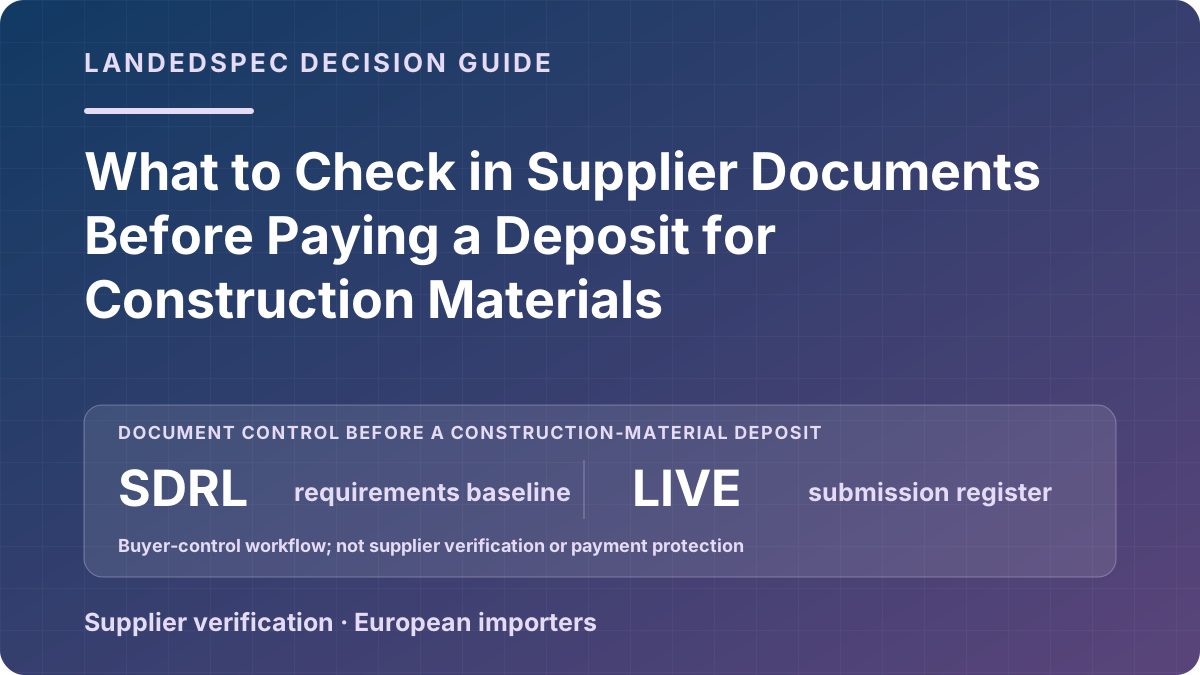
Treat the buyer-approved SDRL or VDR as the requirements baseline, while the supplier document register is the live submission record for actual document numbers, revisions, transmittals, review outcomes, and closeout. A list that only says “certificates required” is not controlled enough to perform either job.
For a construction-material order, record at least these fields before the deposit or purchase-order release:
| Field | Buyer decision it controls |
|---|---|
| Requirement reference | Which buyer requirement or contract line creates the deliverable? Use a buyer-controlled reference; do not invent a standard code. |
| Document type | Is the expected item a drawing, declaration, report, certificate, packing record, instruction, invoice, or another defined deliverable? |
| Product or line scope | Which product, model, batch, manufacturing site, specification revision, or order line must the document cover? |
| Due milestone | Is it due with the quote, before deposit, before production, before inspection, before dispatch, or in the final handover? |
| Submission purpose | Is the supplier sending it for review, approval, information, shipment release, or professional confirmation? Define the buyer's status language in the order. |
| Responsible party | Who prepares it, who reviews it, and who has authority to close the requirement? |
| Format and language | Which file format, language, signature, original, editable file, or translation is actually required? |
| Revision and status | What are the supplier document ID, revision, transmittal date, buyer response, open comment, and next resubmission date? |
| Final dossier | Must the accepted revision be included in the shipment, manufacturing record, technical file, or final handover set? |
Download the printable SDRL PDF for a six-page requirement list, field guide, blank working rows, closeout checklist, and visible scope boundary. Download the Excel SDRL workbook for a four-sheet working file with 27 starter requirements, controlled dropdowns, conditional status formatting, summary formulas, source notes, and a worked powder-coated aluminium profile example. The editable Supplier Document Requirements List CSV remains the lightweight source version. Each is a working starting point, not a universal list: delete non-applicable rows, add product- and destination-specific requirements, and obtain qualified confirmation where the transaction requires it.
Use the wider supplier-document evidence register for the broader supplier-approval, deposit, booking, dispatch, and release workflow. The SDRL template controls expected deliverables and their live submission status; the evidence register controls the wider decision gates. A public SDRL example is evidence of a document-control pattern, not a universal list of documents for every construction product.
Separate the seller, factory, and payment recipient
An order can involve more than one company without being invalid: a manufacturer may sell through a trading company, a group company may receive payment, or a separate finishing plant may perform part of the work. The control is not to assume that every name must be identical. It is to identify each role, document the relationship, and stop when the payment path or production responsibility is unexplained.
| Role | Evidence question | Stop condition |
|---|---|---|
| Contracting seller | Which legal entity issues the quotation and proforma invoice and accepts the order obligations? | The seller name changes between the quotation, invoice, contract, or correspondence without a documented explanation. |
| Manufacturing site | Which named site will make the product, and which processes are performed there or elsewhere? | The claimed factory, trader, subcontractor, or finishing relationship is unclear for the ordered product. |
| Product-evidence holder | Which company, site, model, batch, or system is covered by each declaration, report, certificate, or approval? | Supplier evidence cannot be joined to the actual manufacturer and controlled product revision. |
| Bank beneficiary | Which entity and account will receive the deposit, in which jurisdiction, and why is it connected to the contracting seller? | The beneficiary or account change cannot be independently reconciled to the approved order file. |
Confirm new or changed payment instructions through an independently obtained contact route already associated with the approved supplier—not only by replying to the message that requested the change. Record who performed the check, when it occurred, which contact route was used, and the result. This is a transaction-control step, not a guarantee that the supplier or payment is safe; legal, fraud, sanctions, and payment-protection questions require the appropriate professional review.
Start with the proforma invoice, not the sales promise
Before a deposit is paid, ask the supplier to issue a proforma invoice or equivalent order confirmation that matches the commercial discussion. Review it line by line.
Check for:
- Full supplier legal name and address
- Buyer entity name and delivery country
- Product description that matches the agreed specification
- Quantity, unit of measure, and unit price
- Total order value and currency
- Incoterm and named place or port
- Payment terms, including deposit percentage and balance trigger
- Estimated production lead time
- Packaging assumption if it affects quantity or freight
If the invoice only says something vague like "tiles" or "doors accessories," the document is not strong enough yet. For import work, the product description should be clear enough that your procurement team, forwarder, and customs broker will understand what is being purchased.
Confirm the specification pack is attached or referenced
Many deposit problems start with an incomplete spec, not with a dishonest supplier. The supplier may quote a product that is close to the buyer's request but not identical.
Before payment, confirm that the order is tied to the actual spec set, such as:
- Drawings or technical sheets
- Material grade or composition
- Dimensions and tolerances
- Finish, color, coating, or surface treatment
- Packaging method
- Labeling requirements
- Testing or performance requirements where relevant
If those details sit only in email text or messaging apps, the order can drift later. The cleanest setup is to have the key specification either written into the order document or clearly attached and referenced by version.
Check whether the document set is usable for import, not just for production
A supplier can be good at manufacturing and still weak at export documentation. That distinction matters. Before the deposit, ask what shipment documents the supplier expects to provide and compare that list with what your team usually needs.
Typical items to confirm early include:
- Commercial invoice
- Packing list
- Certificate of origin if applicable to your buying process
- Product test reports or technical declarations where relevant
- Marking, labeling, or packaging data needed by the buyer
You do not need to demand final originals before production starts. You do need confidence that the supplier understands the document package and can produce consistent information later. If basic questions about invoice format, packing breakdown, or origin documentation already create confusion, the risk is visible before the deposit is wired.
Normalize the Incoterm before comparing suppliers
Deposits often get approved on the strength of an apparently attractive quote. Then the buyer discovers that two suppliers quoted under different terms.
Before paying, verify:
- Which Incoterm is being used
- Which named port, terminal, or delivery point applies
- Whether inland transport at origin is included
- Whether export customs handling is included
- Whether insurance is included or excluded
If one supplier quotes EXW and another quotes FOB or DAP, the deposit decision should not be made off the headline price alone. Normalize the route assumption first so the order economics are still valid after logistics costs are added.
Use the packaging assumption as a credibility check
Construction materials often become expensive because of how they are packed, not just how they are made. The supplier should be able to explain how the goods will be packed for the route and how that affects loading.
Ask for:
- Pallet, crate, or loose-load assumption
- Estimated gross weight and net weight
- Packaging dimensions where available
- Expected units per pallet, crate, or container
- Photos of similar export packing if the item is fragile or oversized
This is not only a freight exercise. It is also a signal of supplier readiness. A supplier who cannot explain packaging may still be early in the quoting process, which means the deposit may be funding unresolved execution details.
Review the balance-payment trigger before agreeing to the deposit
The deposit percentage matters, but the balance trigger matters just as much. Check what event allows the supplier to request the final payment.
Common triggers include:
- Before shipment
- Against copy documents
- After inspection
- Before release of original shipping documents
The right structure depends on the product, relationship, and risk tolerance. What matters for the buyer is that the trigger is written clearly and lines up with inspection, shipping control, and document review. If the payment steps are vague, disputes become harder to manage later.
A simple pre-deposit red-flag list
Pause before payment if any of these appear:
- The supplier name changes across documents without explanation
- The product description is too generic for customs or internal approval
- The order quantity or unit of measure is inconsistent across emails and invoice
- The Incoterm is missing or incomplete
- The lead time is promised in chat but absent from the order document
- The supplier cannot say what export documents will be issued
- The spec version is unclear
- The packaging plan is still "to be decided" even though freight sensitivity is high
One red flag does not always kill the order. But each one should be resolved before the deposit converts a sourcing discussion into a committed transaction.
Reconcile fields across documents, not one document at a time
A strong-looking document can still conflict with the rest of the order file. Before payment, compare the same fields across the specification, quotation, proforma invoice, supplier identity evidence, packing assumption, and product-evidence list.
| Field | Documents to reconcile | Stop condition |
|---|---|---|
| Legal entity and beneficiary | Supplier evidence, quotation, proforma invoice, and bank details | The payee is not the contracting supplier and the relationship is unexplained. |
| Product identity | Specification, drawing, model, quotation, and invoice line | Generic wording or a different revision prevents a reliable match. |
| Quantity and units | RFQ, quotation, invoice, packing assumption, and cost model | Pieces, metres, square metres, kilograms, or tolerances cannot be reconciled. |
| Incoterm and named place | Quotation, order confirmation, invoice, and route model | The term, version, exact location, or included legs differ. |
| Required product evidence | Intended use, technical file list, declarations, testing, labels, and instructions | No owner can state what applies, what the supplier will provide, or what remains for professional confirmation. |
| Payment milestone | Proforma invoice, inspection plan, document-review point, and shipping control | Balance payment can fall due before the buyer can verify the agreed evidence. |
Record the result as ready, needs evidence, professional confirmation, or blocker. A blank status should not be interpreted as approval.
A practical approval workflow for buying teams
For a first order, many import teams use a short internal gate before releasing funds:
- Procurement confirms the commercial terms and product spec match the approved quote.
- Logistics or the forwarder reviews the Incoterm, route assumption, and packaging logic.
- The customs broker or qualified advisor flags any classification or import-treatment questions that should be checked before shipment.
- Finance confirms the beneficiary details and payment milestones match the approved order file.
This does not need to be slow. It just needs to happen before the deposit leaves the account.
The practical takeaway
Pre-deposit document review is one of the cheapest risk controls in construction importing. If the document set is clear, the supplier is easier to compare, the shipment is easier to plan, and the next decisions move faster. If the documents are weak, the deposit usually amplifies the problem instead of solving it.
If you want to pressure-test a supplier quote before you commit, request a LandedSpec pilot report. We can turn one product spec and one destination into a practical view of supplier fit, route assumptions, landed-cost structure, and documentation risk.
Primary references
- Port of Argentia: public Supplier Document Requirements List example
- LFH Fluid Control: Supplier Document Requirements List portal
- European Commission: Importing into the EU
- European Commission: EU Customs Tariff (TARIC)
- European Commission: importers and distributors
This checklist is an evidence and workflow tool. Customs treatment, product requirements, conformity, payment protection, and contract terms require transaction-specific professional confirmation.
Dataset reuse: license, attribution, and source terms.