A construction-material buyer receives three quotations for the same project. One is FOB, one is CIF, and one is DAP. The DAP number is highest, so it appears to be the safest comparison. The CIF number includes freight, so it appears close to delivered. The FOB offer is lowest, so it appears to leave the most negotiating room.
None of those conclusions is reliable until the buyer separates the product specification from the transport scope and lists every cost line outside the quotation.
The International Chamber of Commerce describes Incoterms® 2020 as eleven trade rules that allocate costs, risk, and obligations in business-to-business goods contracts. That allocation is essential, but an Incoterm does not classify a product, determine customs value, calculate duty, decide import VAT treatment, verify product compliance, or guarantee a complete door-to-door budget.
For construction materials, the distinction matters because physical characteristics drive the logistics model. A bundle of long aluminium profiles, a container of dense steel, and crates of large-format porcelain slabs can share the same trade term while requiring very different packing, equipment, handling, and final-delivery assumptions.
Short answer: what is the difference between CIF and DAP?
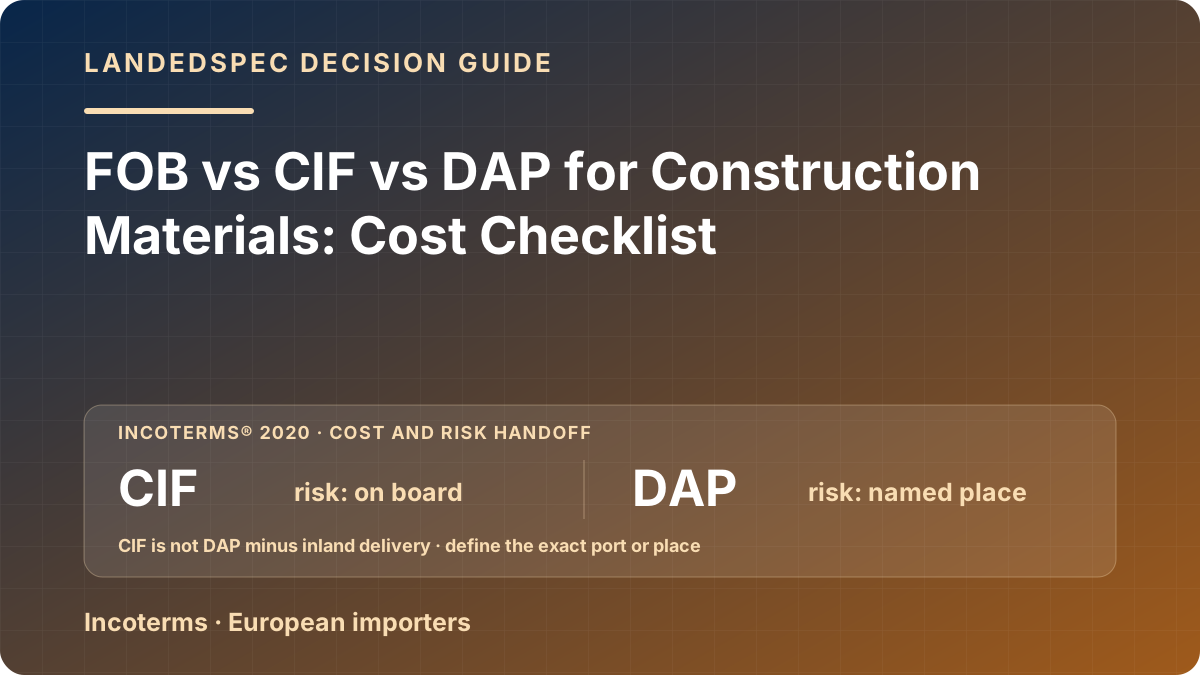
CIF pays the seller-arranged carriage and required insurance to a named destination port, but delivery and risk transfer occur when the goods are loaded on board at the shipment port. DAP keeps the seller's delivery risk through the agreed route until the goods are placed at the buyer's disposal, ready for unloading, at the exact named destination. Under DAP, the buyer handles import clearance and unloading.
| Decision field | CIF | DAP |
|---|---|---|
| Mode and endpoint | Sea or inland-waterway transport to the named destination port. | Any mode or combination of modes to the exact named destination. |
| Seller-arranged carriage | To the named destination port. | To the exact named place and point. |
| Risk transfer | At the shipment port when the goods are loaded on board, not when they reach the destination port. | At the named destination when the goods are ready for unloading. |
| Insurance | The seller obtains the insurance required by the CIF rule; the buyer must still verify coverage, exclusions, and insured value. | The rule does not require either party to insure, although the seller may insure its own delivery risk and the contract can require coverage. |
| Import and unloading | The buyer handles import clearance, duty, tax, inland delivery, and unloading after the destination port unless the contract expressly allocates a cost differently. | The buyer handles import clearance, duty, tax, and unloading; the seller's carriage ends at the agreed ready-for-unloading point. |
Download the editable CIF/DAP construction quote-comparison worksheet (CSV). Its 40 decision rows put CIF, DAP, and FOB responses beside the same buyer input and keep the evidence source, confidence, and next action visible for every scope or cost line. For a working comparison, download the Excel CIF/DAP quote-comparison workbook. The five-sheet file preserves the CSV source, adds 10 blank working rows, keeps scope assumptions separate from numeric amounts, controls confidence and status, and calculates the selected subtotal, import VAT cash requirement, and comparison cash requirement without treating the result as a customs, tax, legal, insurance, or carrier determination.
CIF is not DAP minus inland delivery. The two rules have different delivery and risk-transfer points as well as different mode, insurance, and destination obligations. A quoted term alone also does not prove how every terminal or carrier charge will be billed. Require the Incoterms® 2020 rule, precise named port or place, route, charge allocation, insurance evidence where relevant, import-clearance owner, and unloading scope in the quotation.
Copy this instruction into the quotation request
> Quote the controlled product and packing under [CIF named destination port] or [DAP exact named place and point], Incoterms® 2020. State the transport mode and route, seller-arranged carriage endpoint, delivery and risk-transfer point, insurance obligation and proposed coverage, every charge billed outside the quoted price, import-clearance/duty/tax owner, unloading and access scope, waiting or exception-cost allocation, rate validity, and evidence source for each answer.
This instruction does not choose the rule or rewrite the official terms. It makes the supplier, forwarder, customs, site-delivery, and buyer assumptions reviewable before prices are normalized.
Is CIF the same as DAP?
No. CIF is a sea or inland-waterway rule: the seller arranges carriage and the rule's required insurance to the named destination port, but risk transfers when the goods are loaded on board at the shipment port. DAP can be used with any mode: the seller keeps delivery risk to the exact named destination where the goods are ready for unloading, while the buyer handles import clearance and unloading.
Which is better, CIF or DAP?
Neither is automatically better. DAP can reduce the buyer's transport execution and risk before the named destination, but it still leaves import clearance, duty, tax, and unloading with the buyer. CIF can be commercially useful when the buyer is equipped to control destination handling and inland delivery, but a freight-included CIF price is not a delivered-cost result. Choose only after both offers use the same product, packing, route, named point, outside-cost schedule, and evidence standard.
CIF and DAP difference example for construction materials
Assume a buyer is comparing the same fictional 20-tonne order of powder-coated aluminium profiles. The specification, quantity, packing, origin, destination, and quotation date are held constant. The figures below are arithmetic only—not current freight rates, duty, tax, customs-value, insurance, or buying advice.
| Illustrative decision line | CIF Hamburg port | DAP buyer warehouse |
|---|---|---|
| Supplier quotation | €31,000 | €32,700 |
| Destination terminal/carrier charges confirmed outside the quote | €850 | Supplier confirms included to the named point |
| Customs representation handled by buyer | €200 | €200 |
| Inland delivery to the same warehouse | €750 | Supplier confirms included to the named point |
| Unloading handled by buyer | €250 | €250 |
| Illustrative operational subtotal before separately confirmed duty and import VAT | €33,050 | €33,150 |
| Delivery-risk boundary | Buyer bears transit risk after loading on board at the shipment port, subject to the contract and CIF insurance | Seller bears delivery risk to the named warehouse point, ready for unloading |
In this example, the normalized CIF subtotal is only €100 lower. That gap does not prove CIF is better: the buyer also takes the earlier risk handoff and more destination execution. A different terminal bill, route exception, insurance requirement, customs-value treatment, or delivery constraint can reverse the result. Keep duty and import VAT as separately confirmed calculations, and do not treat this operational comparison as a customs valuation.
Use the same structure with real, dated quotations: CIF comparison subtotal = CIF quote + every confirmed buyer-side destination, import-support, inland-delivery, unloading, and exception cost. DAP comparison subtotal = DAP quote + every confirmed buyer-side import, unloading, and exception cost. Unknown amounts stay open instead of being set to zero.
Short answer: is FOB, CIF, or DAP best for construction materials?
FOB, CIF, and DAP are not automatically cheaper or safer than one another. Compare them only after every supplier quotes the same product specification, quantity, packing, Incoterms® 2020 rule, and exact named port or place. Then add every cost outside the quoted scope—including main freight, insurance, destination charges, customs representation, duty, import VAT cash, inland delivery, unloading, waiting, and route-specific risk—so all offers reach the same delivered decision point.
Start with a controlled product specification
A freight comparison is meaningless if the suppliers have not quoted the same product. Before comparing Incoterms, normalize:
- grade, alloy, composition, or relevant product designation;
- drawing revision, dimensions, and tolerances;
- finish, coating system, colour, and acceptance criteria;
- unit weight, total net weight, and quantity tolerance;
- tooling ownership and tooling or sampling charges;
- test reports, declarations, and other documents expected with the order;
- export packing design, bundle or crate dimensions, gross weight, and markings.
This catches a common false saving. One aluminium-profile quotation may include protective film, interleaving, export bundling, and a defined powder-coat acceptance standard. Another may include only mill-finished profiles in basic wrapping. The lower unit price is not a lower price for the same deliverable.
Use the construction-material RFQ template to collect comparable product, tooling, packing, commercial, and evidence fields.
Carry the controlled specification into the FOB/CIF/DAP construction quote-comparison worksheet. It places three supplier quotations beside one buyer-controlled scope and leaves a source, confidence, and next-action field for every cost line.
Treat the Incoterm as a handoff map
Record the agreed rule, version, and named port or place exactly. “FOB China” or “DAP Germany” is not precise enough.
| Term | Commercial handoff to model | Buyer still needs to expose |
|---|---|---|
| FOB | For sea or inland-waterway transport, the seller delivers the goods on board at the named shipment port and clears export. | Main carriage, insurance, destination charges, import clearance, duty, import VAT, final delivery, and unloading. Confirm whether FCA better matches a container handoff before loading on the vessel. |
| CIF | The seller arranges cost, freight, and the rule's required insurance to the named destination port, while risk transfers at the origin shipment point defined by the rule. | Destination charges, insurance adequacy, import clearance, duty, import VAT, inland delivery, and unloading. Freight included does not mean delivered cost. |
| DAP | The seller arranges the route to the precise named destination and presents the goods ready for unloading. | Import clearance, duty, import VAT, unloading, access, appointment, waiting time, and exception handling. |
The table is an orientation, not a substitute for the official rules or contract review. For containerized or multimodal movements, confirm with a competent trade or logistics adviser that the selected rule matches the physical handoff.
Three questions make the boundary operational:
- Which party arranges each movement and clearance step?
- At what point does risk transfer under the agreed rule?
- Which charges remain outside the seller's price even if the seller arranges main carriage?
The third question is where many comparisons fail.
Cost lines to request under every quotation
The following headings turn unlike quotations into one comparable model.
Product and origin
- goods value under the controlled specification;
- tooling, samples, testing, and inspection;
- export packing and load securing;
- collection or inland haulage at origin;
- export declaration, terminal, and origin handling;
- documentation, security, or other shipment-specific charges.
Main carriage
- ocean, road, rail, or air freight;
- surcharges and quotation validity;
- insurance scope, insured value, exclusions, and deductible;
- transshipment or consolidation assumptions;
- equipment type and utilization assumption.
Destination and import
- destination terminal, port, or carrier charges;
- customs representation and disbursement fees;
- customs-value methodology and required additions;
- tariff classification and origin evidence to be confirmed;
- estimated duty based on confirmed classification, origin, and current measures;
- import VAT cash-flow treatment, kept distinct from irrecoverable cost where appropriate;
- inspections, storage, demurrage, detention, or waiting time;
- delivery from the terminal or hub to the final site or warehouse;
- unloading, crane, forklift, access, appointment, or out-of-hours requirements.
The European Commission explains that customs value, origin, and classification are separate inputs used to calculate duty. Its import VAT guidance also says the taxable amount can include customs value, duties, and incidental expenses not already included. A commercial label such as CIF or DAP does not replace those determinations.
Dense and fragile cargo fail differently
For dense steel products, weight may constrain the movement before container volume. A buyer who compares price per tonne without checking payload, bundle weight, floor loading, lifting points, and delivery equipment can understate the number of units or vehicles required. Waiting time and unloading constraints can turn a small destination gap into a material cost.
For large-format porcelain slabs, nominal container utilization is only one part of the answer. Crate design, approved orientation, bracing, handling method, batch identification, and breakage procedure affect cost and loss exposure. A cheaper freight scope is not comparable if it relies on weaker crates or leaves specialist unloading unspecified.
Long aluminium profiles add a third pattern. Length can determine equipment choice even when the cargo is relatively light. Finish protection, bundle geometry, rack or stillage return, and abrasion or deformation risk may matter more than the quoted freight per kilogram.
The Incoterm cannot correct an invalid packing or equipment assumption.
Build three totals, not one
A defensible comparison separates:
- Landed cost before import VAT — product, origin, main carriage, destination, duty, and other irrecoverable import costs.
- Import VAT cash requirement — shown separately and validated against the importer's tax position and national arrangements.
- Delivered operational cost — landed cost plus final delivery, unloading, expected handling, and a clearly labelled risk allowance.
This prevents import VAT from being silently treated as a permanent cost when it may be recoverable, while still showing the cash requirement. It also prevents an optimistic port-arrival number from being presented as a warehouse or site cost.
Every estimate should show its source, currency, date, validity, and confidence. Live freight, duty measures, and exchange rates change. Unknowns should remain visible rather than being replaced with invented precision.
Enter the normalized cost lines in the construction-material landed-cost calculator, which keeps economic cost and import VAT cash need separate.
FOB, CIF, and DAP comparison checklist
Before approving a quotation, confirm:
- the same controlled product specification and quantity;
- the exact Incoterm rule, version, and named place;
- packing dimensions, net and gross weights, and loading plan;
- origin collection, export, terminal, and documentation scope;
- main-carriage rate, validity, routing, surcharges, and insurance;
- every destination charge and free-time assumption;
- classification, origin, customs value, and duty questions assigned for confirmation;
- import VAT shown separately from irrecoverable cost;
- final address, delivery equipment, access, appointment, waiting, and unloading;
- evidence or executable quotation needed before the purchase order.
If one supplier cannot answer these fields, the comparison is not complete. Do not fill the gaps with the other supplier's assumptions.
The decision is an evidence request
The right output is not simply “choose FOB” or “choose DAP.” It is a short list of evidence that would change the decision.
For one order, that may be a packing drawing and destination-charge schedule. For another, it may be a confirmed tariff classification, origin document, refrigerant declaration, or final-mile site survey. For a third, it may be a revised supplier quotation using the same drawing revision and acceptance criteria as its competitor.
Incoterms create a common contractual language. Buyers make that language commercially useful by pairing it with a controlled specification, a complete cost-line request, and an explicit evidence gate before the purchase order.
Primary references
- International Chamber of Commerce: Incoterms® 2020
- ICC Academy: choosing between Incoterms® 2020 C and D rules
- European Commission: calculation of customs duties and customs valuation
- European Commission: tariff classification of goods
- European Commission: import VAT taxable amount
This guide is educational and does not replace the official Incoterms® rules or product-specific legal, customs, tax, conformity, insurance, or logistics advice.
Dataset reuse: license, attribution, and source terms.